Go to content (click on Intro)
UdG Home UdG Home
Close
Menu

Master in Intelligent Robotic Systems (MIRS)

Access, admission and enrolment

The recommended admission profile for students of the master's degree is that of graduates in industrial, electrical or mechanical engineering, electronics, computer science, robotics, physics or mathematics. Other related fields will be taken into account, according to their academic record and curriculum.

Successfully admitted students will have to accredit:

  • They have a bachelor's degree (minimum 180 ECTS) in engineering or another bachelor's degree with similar core subjects.
  • They have a suitable level of English to follow the courses - B2 level (or equivalent).

They have the motivation to study and the importance of their professional development.

MIRS timeline

This section provides essential information and guidance to support you on your journey from pre-enrolment to arrival in Girona. Below you will find a detailed timeline outlining the key steps you need to follow, from gathering the required documentation to completing your enrolment. We also provide downloadable resources to help you prepare for your studies, ensuring smooth integration into the MIRS programme.
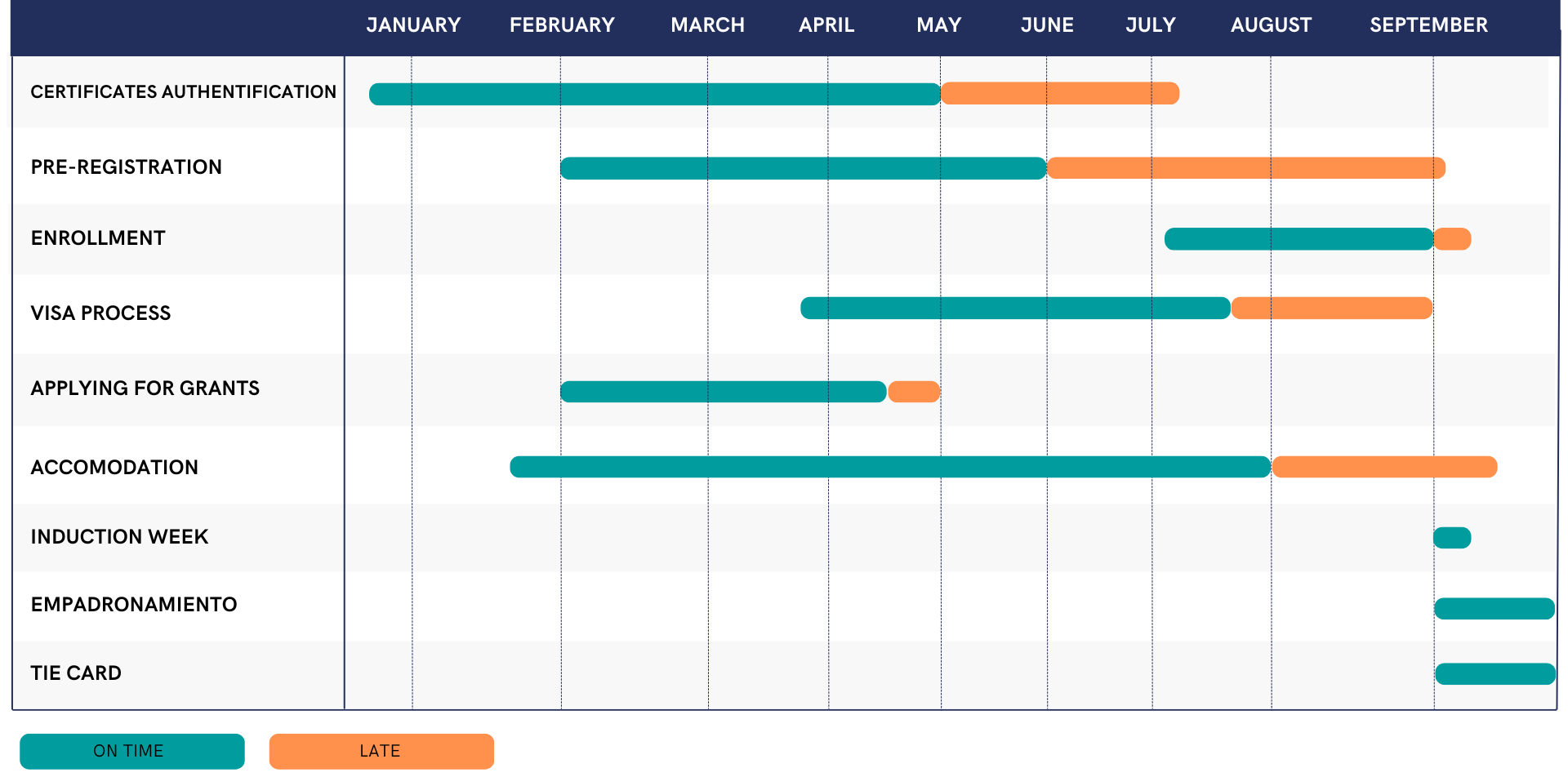
During this period, you will need to complete the essential steps to secure your place on the Master in Intelligent Robotic Systems (MIRS) programme at the University of Girona. This includes the presentation of the required documentation and the payment of the pre-enrolment fee.

This is the official process where you apply for the MIRS programme. Applicants must submit the necessary documents, such as passport, CV, letter of motivation, academic transcripts and university degree certificates, and pay the pre-enrolment fee. Ensure that all documents are submitted in English, Spanish or Catalan.

International students will also need to obtain a Degree Equivalence Certificate from the Ministry of Education and Vocational Training to validate their bachelor’s degree in Spain.

For more detailed information and next steps, please refer to the attached documents.

The MIRS offers grants for first and second year students. Generally, the call opens in February and the application deadline is usually at the beginning of May. These grants can help to partially or totally cover the cost of the master.

For more information about the requirements, time frames and procedure, go to the page "Scholarships and Grants"

The enrolment period for the MIRS Master is from June to September. Even though enrolment can be carried out during this period, students are advised to do so during this time as they need proof of enrolment to ask for a visa (in many cases, proof of payment). Enrolling in this period gives enough time to apply for a visa without hurrying.

Review the essential resources for the programme, including tutorials on Python, Artificial Intelligence, Machine Learning and Robotics. We also recommend you obtain a laptop with a dedicated GPU for computing tasks.

For more details, see the attached document, where you will find all the information.

Apply for a student visa at the Spanish Consulate. The documents usually required include the University Acceptance Letter, proof of valid health insurance, letter of motivation, proof of accommodation and academic certificates. Make sure you have the documents notarised and translated if necessary. See the detailed visa guide attached.

Once you have been accepted on the Master in Intelligent Robotic Systems (MIRS) programme, you can start looking for accommodation.

If you plan on lodging in one of the campus halls of residence, we strongly recommend you reserve your place at least 5 or 6 months before arriving in Girona, as places are limited.

Alternatively, you can find private accommodation in the city. You have several options available, including shared flats and individual lets. To facilitate the process, you can use estate agencies or online platforms that you will find in the attached documents.

It is highly recommended you sort out accommodation before arriving in Spain, especially if you arrive in September, because it can be especially difficult to find a place in that period as they are in great demand.

For more detailed information and next steps, please refer to the attached documents.

After getting your accommodation, you have to register your address with Girona City Council. This process, known as empadronamiento, is essential for legal residence in Spain.

To request inclusion on the municipal register of residents (empadronamiento), you will have to present the following documents:

  • Passport: Original and a photocopy.

  • Photograph of your identification card: A recent photograph in colour (32 x 26 mm) with white background.

  • Rental contract: A document that proves that you have found accommodation, provided by the owner.

  • Receipt of payment: A transfer receipt or slip that proves payment for the accommodation.


After registering your address, the next step is to get a TIE card (Tarjeta de Identidad de Extranjero, i.e. Foreign national ID number). You need this document so you can legally remain in Spain after the duration of your student visa.

You must make sure you request and receive the TIE card before your student visa expires to avoid any legal complications.

For more detailed information and next steps, please refer to the attached documents.

Settling in a new city implies taking the practical steps to ensure that your daily needs are covered. Here are some key aspects to help you find your way round Girona:

  • Banks: It is essential you open a bank account in order to manage your finances while you live in Spain. You can open one in most local banks with the necessary documentation, including your passport and TIE card.

  • What to do if you feel ill: Your health is important, and it is essential to know what to do if you feel ill. As a student, you will be covered by the health insurance provided by the university or you can take out private insurance. In the event of illness, visit your local health centre or request medical attention.

  • Transport options: Girona offers some convenient public transport options, including buses and trains. You can get a travel pass to make travel more affordable, or opt to get around the city by bicycle.

  • General Services: From rubbish collection to the postal services, knowing how to access general services will make your life easier. Make sure you familiarise yourself with local regulations and the services available to you as a resident.

For more detailed information and next steps, please refer to the attached documents.

Choose which types of cookies you accept which the University of Girona can store in your browser.

Those that are essential for enabling your connection.There is no option for disabling them, as they are necessary for the functioning of the website.

These enable your options to be remembered (for example language or region you are accessing from), to provide you with advanced services.

They provide statistical information and enable improved services.We use Google Analytics cookies which you can deactivate by installing this plugin.

To offer advertising contents relating to the interests of users, either directly, or through third parties (“adservers”). These must be activated if you wish to see the YouTube videos uploaded to the University of Girona’s website.