Specialised Course in Animal Behaviour.
The main objective of the course is to understand the key concepts and fundamentals of animal behaviour from an interdisciplinary and integrative perspective. More specifically, the course aims to:
- Provide an understanding of the causal mechanisms underlying animal behaviour, from both a proximal and a phylogenetic perspective, taking into account both endogenous and exogenous factors, as well as the biological and environmental factors that shape individual behaviour.
- Accurately and appropriately apply the concepts and terminology specific to ethology and comparative psychology.
- Analyse the various theoretical models and approaches to the study of animal behaviour.
- Identify the aspects, areas and processes that contribute to explaining human behaviour through a comparative study of animal behaviour.
- Understand the practical applications of animal behaviour science in the field of conservation and in the welfare of animals in human care.
- Present the main advances in ethology, comparative psychology, behavioural ecology, learning, cognition, social and sexual behaviour, as well as in applied ethology, from a broad, critical, reflective and rigorously grounded perspective.

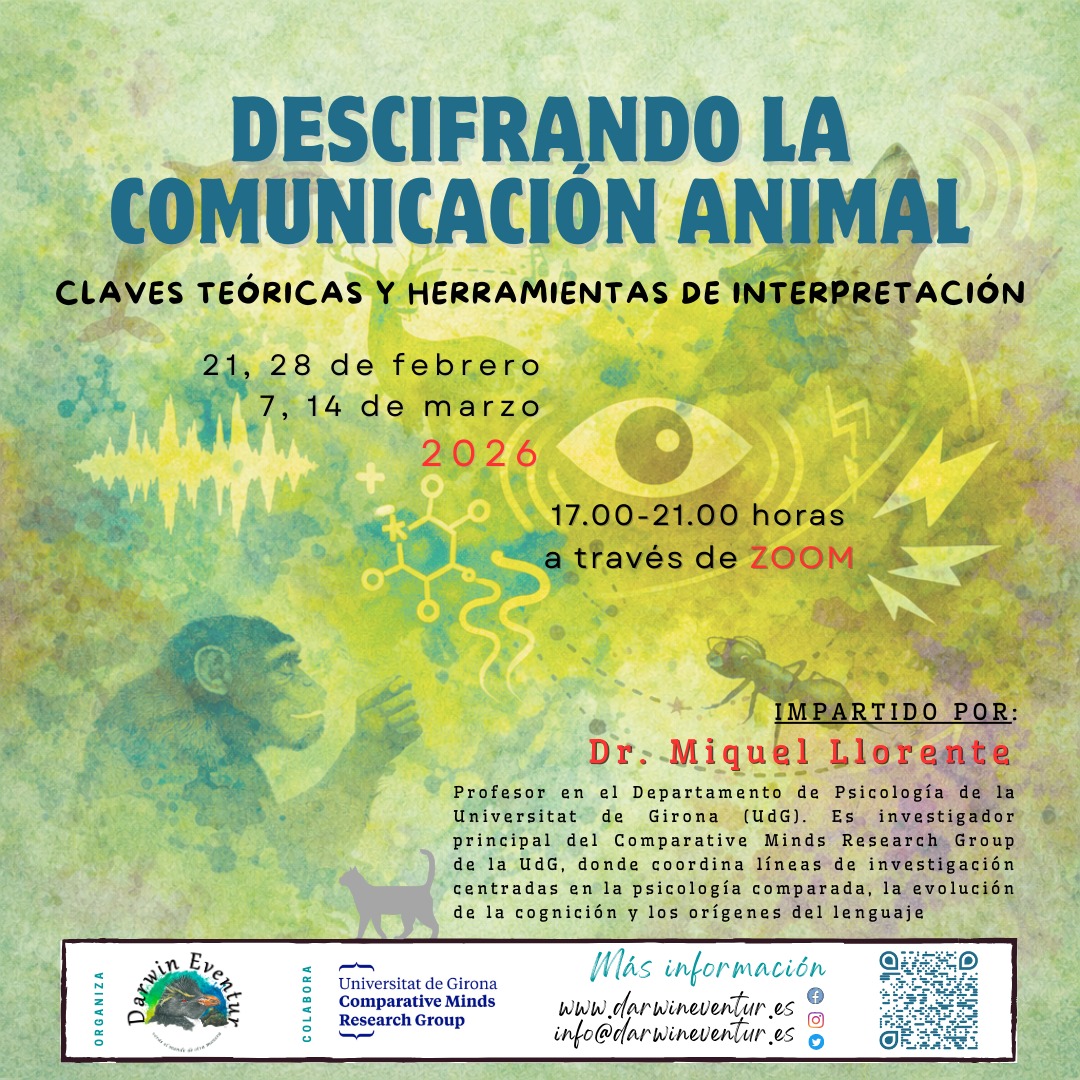
Deciphering animal communication. Theoretical keys and interpretative tools.
Animal communication is the scientific study of how organisms produce, transmit and receive information through acoustic, visual, chemical, tactile and electrical signals, and how these signals influence behaviour, social organisation and evolution. It is an interdisciplinary field that combines theoretical frameworks (informative signalling vs. manipulation, comparative cognition), the analysis of communication channels and codes, and practical methodologies such as systematic observation, bioacoustics and the recording of ethograms.
In the course ‘Deciphering Animal Communication’, you'll learn to identify these signals, understand the principles that govern them and use practical tools (observation, bioacoustics, ethograms and visual analysis) to interpret them correctly.
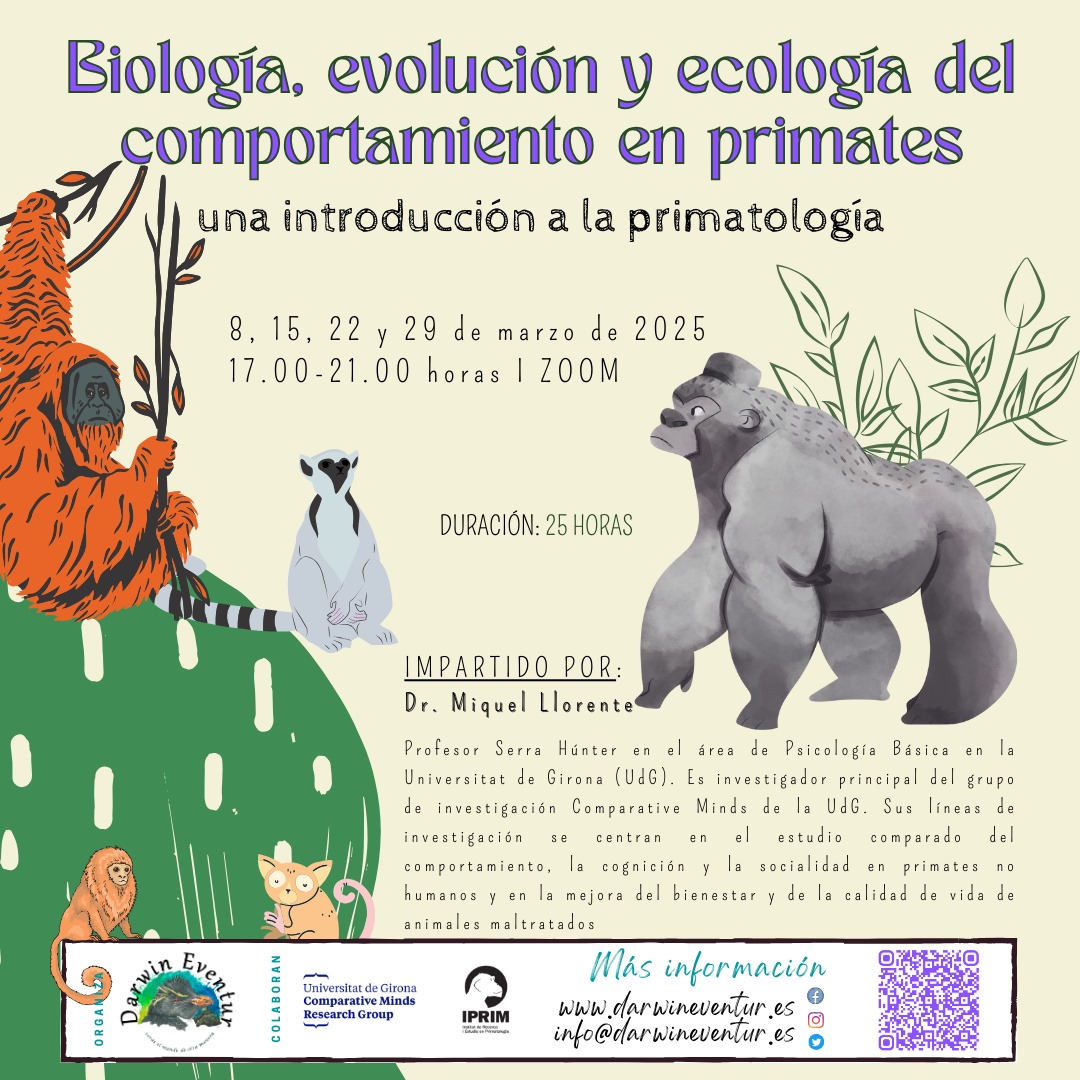
Biology, evolution and ecology of behaviour in primates.An introduction to primatology
Primatology is the scientific study of primates, and it is an extremely diverse science on the limit between mammalogy and anthropology, where we can find researchers in academic departments in different disciplines such as anatomy, anthropology, biology, medicine, psychology, veterinary sciences and zoology.Their scope of study ranges from the anatomy of the ancestors of primates to field studies about the behaviour and ecology of current species.
Duration: 25 hours
More information:
Ethology, cognition and conservation of primates.An advanced vision of primatology
Primatology is focused as much on the social behaviour and cognitive abilities of these species as it is on the challenges for their conservation.It explore the social structures, reproduction strategies and intelligence of primates, as well as the threats resulting for the destruction of their habitat and illegal hunting.In addition, primatology investigates different conservation strategies, in situ and ex situ, for protecting these species and their ecosystems.
Duration: 25 hours
More information:

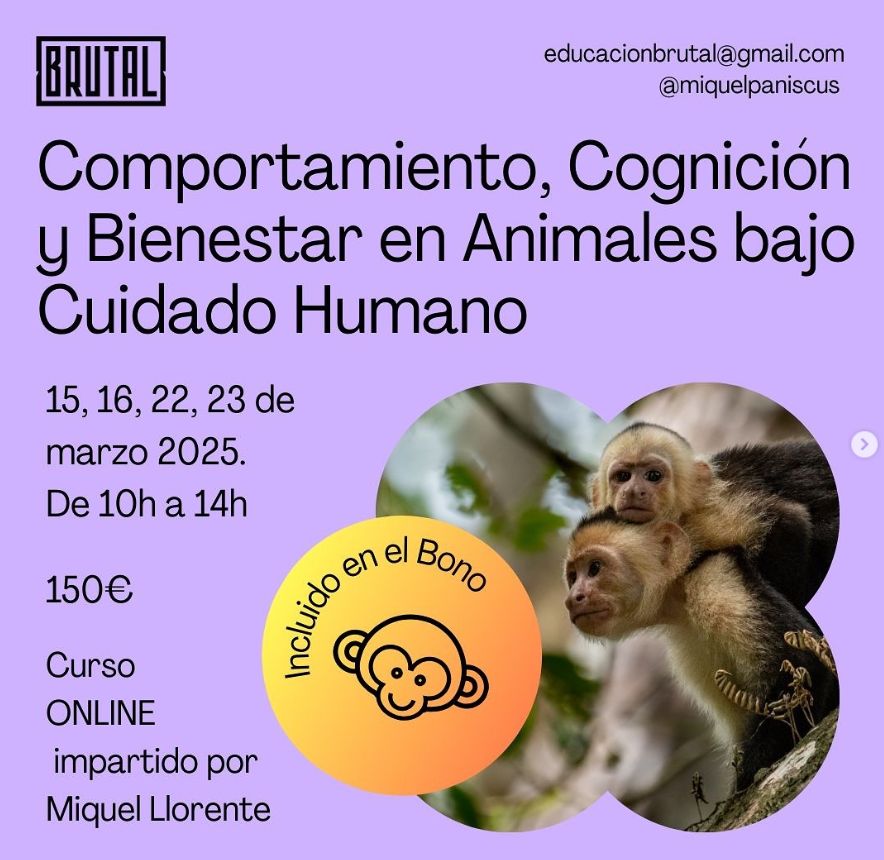
Behaviour, cognition and well-being of animals in human care
The course “Behaviour, cognition and well-being of animals in human care” is designed to give participants a deep and up-to-date understanding of the factors that influence animal well-being in controlled environments such as zoos, rehabilitation centres and shelters.Over four intensive days, the course will look at key themes such as applied ethology, animal cognition, personality and emotions, all of them inter-related with the well-being and quality of life of animals in human care.The course adopts an integrating and practical approach, combining theory with applied examples of enrichment actions, behaviour assessment and strategies for improving the mental and emotional health of animals.Participants will learn to identify and apply scientific tools to evaluate and improve well-being, taking into
account the cognitive and emotional particularities and personality of each species.
Duration: 25 hours
More information: